


02 July 2026
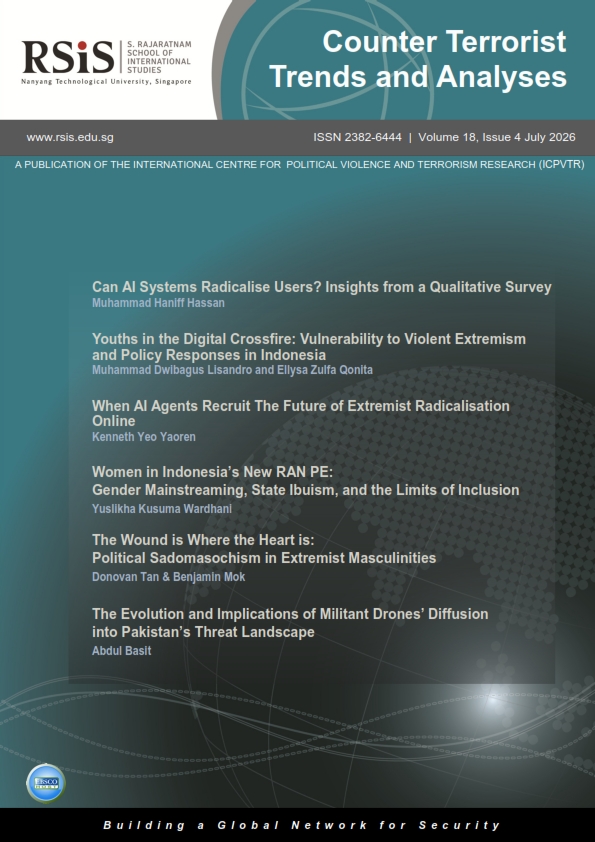
Counter Terrorist Trends and Analyses (CTTA) – Volume 18 Issue 04

Editorial Note: Emerging Technologies and the Evolution of Contemporary Terrorism
Emerging technologies have altered contemporary terrorism significantly by reducing radicalisation timespans, lowering the average age of would-be radicals, shifting recruitment and narrative dissemination to digital platforms, and making women’s roles more prominent. Two trends in particular have underpinned these rapid transformations: 1) the slowly diminishing salience of extremist groups and ideologies and 2) the growing role of individuals (read lone actors) and personal grievances in radicalisation. These two trends do not cut uniformly across various geographies and conflict zones, such as those in Asia and Africa, where groups and ideologies are still the potent vehicles to channel multiple types of grievances. However, in Western societies and some Southeast Asian countries, individual grievances have been found to be the main factors, among others, of radicalisation.
Concurrently, the roles of women within terrorist organisations have implicitly transformed and expanded. While continuing to perform their longstanding secondary roles as propagandists, preachers, matchmakers and caregivers, women are now also at the frontlines of insurgent and terrorist movements as foot soldiers, suicide bombers and even commanders. While the percentage of women in lone-actor terrorism is still low as compared to their male counterparts, research indicates that female participation across the ideological spectrum is expanding.
This presents terrorism studies’ academics and practitioners with a complex and fluid threat picture where old trends persist alongside new ones in a decentralised manner. For instance, instead of a shared ideology driving radicalisation, personal grievances—like revenge, frustration, anger, or a lack of purpose—have become key drivers. In a fragmented environment where the presence of various digital and social media platforms offers multiple potential violent pathways to disenfranchised individuals, new conceptual and policy frameworks are needed to grapple with the hybrid realities that confront contemporary terrorism.
In light of this, the current issue features six articles looking at the evolving nature of ideologies, personal grievances and their intersection; transforming roles of women both in violent extremism as well as preventing and countering violent extremism (P/CVE). The issue also highlights the potential risks concerning Agentic AI in terrorist recruitment and radicalisation, and the growing use of unmanned aerial vehicles by terrorists for spying and violent operations.
First, Muhammad Haniff Hassan examines the responses of Islamic and non-Islamic Artificial Intelligence (AI) systems to queries on Islamism and jihadism, assessing their tone, normative positioning, contextualisation, and neutrality. The author notes that while all such systems uniformly reject jihadism, responses on Islamism vary widely and may shape users’ ideological orientation. The findings of this piece correspond to the ongoing discussion on AI governance and counter extremism policy.
Next, Muhammad Dwibagus Lisandro and Ellysa Zulfa Qonita explore the growing vulnerability of youth to violent extremist indoctrination and recruitment within Indonesia’s digital landscape, despite an overall decline in terrorism-related activity in the country. Extremist actors—religiously motivated and otherwise—exploit algorithm-driven social media, interactive gaming platforms and the internet’s shared cultural language to normalise violence and influence younger audiences. Youth, in turn, are particularly susceptible to extremist influence owing to a combination of social, neurobiological and psychological factors. The authors parse Indonesia’s soft and hard policy responses to this trend, including counter-narrative promotion, content moderation and recent legislation, to point out existing enforcement and assessment gaps. They argue that protecting youth from extremist recruitment and indoctrination requires a shift from restriction to resilience, such as by integrating critical thinking and media literacy skills into formal education.
Third, Kenneth Yeo Yaoren debates how emerging technologies—generative and agentic AI, in particular—may be adopted and exploited by extremists across the ideological spectrum for radicalisation and recruitment online. He highlights three key developments and risks associated with generative AI: improved access to extremist content through automated translation; increased propaganda output via AI-generated media; and less labour-intensive yet more personalised radicalisation using chatbots. However, the greater security threat lies in agentic AI systems. More specifically, the potential weaponisation by extremist actors of agentic proselytisers requires closer scrutiny. Such autonomous systems have the capacity to identify vulnerable individuals, draw them into insidious online communities, and facilitate personalised radicalisation processes at scale. To delay or prevent the emergence of the agentic extremist proselytiser, the author recommends that policymakers and technology corporations put safeguards in place to prohibit autonomous human outreach as well as the creation and operation of synthetic personas by AI agents.
In the fourth article, Yuslikha Kusuma Wardhani examines Indonesia’s National Action Plan for the Prevention and Countermeasures of Violent Extremism Leading to Terrorism (RAN PE) 2026–2029 through the lens of Julia Suryakusuma’s concept of State Ibuism. The author argues that while the latest RAN PE framework represents some progress in incorporating gender mainstreaming in P/CVE efforts, it nevertheless continues to position women primarily within the conventional roles of mothers, caregivers, peace agents and family resilience builders. This gender essentialist approach is not only a normative limitation but also a security concern, as it distorts threat assessments, weakens rehabilitation and reintegration efforts, and underuses women-led civil society actors in P/CVE cooperation. Effective gender mainstreaming should instead recognise women as complex security-relevant actors and strategic partners, to address enduring and important blind spots.
In the next article, Donovan Tan and Benjamin Mok reason that conventional models for assessing extremists assume that violence is motivated by an ideological (e.g. political, religious or strategic) objective. According to the authors, while such approaches can explain ideologically driven extremists, they struggle to account for individuals fundamentally organised around grievance and conflict itself. Drawing on Casey Ryan Kelly’s concept of political sadomasochism and Lacanian psychoanalysis, an alternative framework for understanding extremist rationality is offered. From this perspective, extremists derive meaning from maintaining cycles of antagonism, injury, and struggle rather than resolving them. Its applicability is then demonstrated across three diverse cases: the Christchurch shooter’s manifesto, Japan’s far-right movement, and online incel communities. The article also contends that misidentifying such actors as conventional ideologues can undermine P/CVE efforts.
Lastly, Abdul Basit has assessed the growing role of commercial, off-the-shelf drones for spying and attacks by Pakistani terrorist groups. The author notes that between 2025 and 2026, two Pakistani terrorist groups Tehreek-e-Taliban Pakistan (TTP) and the Baloch Liberation Army (BLA), formally announced their drone units. At the same time, Ittehad-ul-Mujahideen Pakistan (IMP), an alliance of Hafiz Gul Bahadur Group, Lashkar-e-Islam and Harakat-e-Inqilab-e-Islami Pakistan, has been deploying UAVs for terrorist attacks without declaring a formal unit. After examining drone capabilities of Pakistani terrorist networks, the author probes their shifting operational tactics from mountain-based tribal warfare to tech-driven urban guerrilla warfare. In doing so, he outlines the potential asymmetric advantages and implications of this development for Pakistan’s internal security landscape.
HTML Article Versions
Can AI Systems Radicalise Users? Insights from a Qualitative Survey
When AI Agents Recruit The Future of Extremist Radicalisation Online
Women in Indonesia’s New RAN PE: Gender Mainstreaming, State Ibuism, and the Limits of Inclusion
The Wound is Where the Heart is: Political Sadomasochism in Extremist Masculinities
The Evolution and Implications of Militant Drones’ Diffusion into Pakistan’s Threat Landscape
Editorial Note: Emerging Technologies and the Evolution of Contemporary Terrorism
Emerging technologies have altered contemporary terrorism significantly by reducing radicalisation timespans, lowering the average age of would-be radicals, shifting recruitment and narrative dissemination to digital platforms, and making women’s roles more prominent. Two trends in particular have underpinned these rapid transformations: 1) the slowly diminishing salience of extremist groups and ideologies and 2) the growing role of individuals (read lone actors) and personal grievances in radicalisation. These two trends do not cut uniformly across various geographies and conflict zones, such as those in Asia and Africa, where groups and ideologies are still the potent vehicles to channel multiple types of grievances. However, in Western societies and some Southeast Asian countries, individual grievances have been found to be the main factors, among others, of radicalisation.
Concurrently, the roles of women within terrorist organisations have implicitly transformed and expanded. While continuing to perform their longstanding secondary roles as propagandists, preachers, matchmakers and caregivers, women are now also at the frontlines of insurgent and terrorist movements as foot soldiers, suicide bombers and even commanders. While the percentage of women in lone-actor terrorism is still low as compared to their male counterparts, research indicates that female participation across the ideological spectrum is expanding.
This presents terrorism studies’ academics and practitioners with a complex and fluid threat picture where old trends persist alongside new ones in a decentralised manner. For instance, instead of a shared ideology driving radicalisation, personal grievances—like revenge, frustration, anger, or a lack of purpose—have become key drivers. In a fragmented environment where the presence of various digital and social media platforms offers multiple potential violent pathways to disenfranchised individuals, new conceptual and policy frameworks are needed to grapple with the hybrid realities that confront contemporary terrorism.
In light of this, the current issue features six articles looking at the evolving nature of ideologies, personal grievances and their intersection; transforming roles of women both in violent extremism as well as preventing and countering violent extremism (P/CVE). The issue also highlights the potential risks concerning Agentic AI in terrorist recruitment and radicalisation, and the growing use of unmanned aerial vehicles by terrorists for spying and violent operations.
First, Muhammad Haniff Hassan examines the responses of Islamic and non-Islamic Artificial Intelligence (AI) systems to queries on Islamism and jihadism, assessing their tone, normative positioning, contextualisation, and neutrality. The author notes that while all such systems uniformly reject jihadism, responses on Islamism vary widely and may shape users’ ideological orientation. The findings of this piece correspond to the ongoing discussion on AI governance and counter extremism policy.
Next, Muhammad Dwibagus Lisandro and Ellysa Zulfa Qonita explore the growing vulnerability of youth to violent extremist indoctrination and recruitment within Indonesia’s digital landscape, despite an overall decline in terrorism-related activity in the country. Extremist actors—religiously motivated and otherwise—exploit algorithm-driven social media, interactive gaming platforms and the internet’s shared cultural language to normalise violence and influence younger audiences. Youth, in turn, are particularly susceptible to extremist influence owing to a combination of social, neurobiological and psychological factors. The authors parse Indonesia’s soft and hard policy responses to this trend, including counter-narrative promotion, content moderation and recent legislation, to point out existing enforcement and assessment gaps. They argue that protecting youth from extremist recruitment and indoctrination requires a shift from restriction to resilience, such as by integrating critical thinking and media literacy skills into formal education.
Third, Kenneth Yeo Yaoren debates how emerging technologies—generative and agentic AI, in particular—may be adopted and exploited by extremists across the ideological spectrum for radicalisation and recruitment online. He highlights three key developments and risks associated with generative AI: improved access to extremist content through automated translation; increased propaganda output via AI-generated media; and less labour-intensive yet more personalised radicalisation using chatbots. However, the greater security threat lies in agentic AI systems. More specifically, the potential weaponisation by extremist actors of agentic proselytisers requires closer scrutiny. Such autonomous systems have the capacity to identify vulnerable individuals, draw them into insidious online communities, and facilitate personalised radicalisation processes at scale. To delay or prevent the emergence of the agentic extremist proselytiser, the author recommends that policymakers and technology corporations put safeguards in place to prohibit autonomous human outreach as well as the creation and operation of synthetic personas by AI agents.
In the fourth article, Yuslikha Kusuma Wardhani examines Indonesia’s National Action Plan for the Prevention and Countermeasures of Violent Extremism Leading to Terrorism (RAN PE) 2026–2029 through the lens of Julia Suryakusuma’s concept of State Ibuism. The author argues that while the latest RAN PE framework represents some progress in incorporating gender mainstreaming in P/CVE efforts, it nevertheless continues to position women primarily within the conventional roles of mothers, caregivers, peace agents and family resilience builders. This gender essentialist approach is not only a normative limitation but also a security concern, as it distorts threat assessments, weakens rehabilitation and reintegration efforts, and underuses women-led civil society actors in P/CVE cooperation. Effective gender mainstreaming should instead recognise women as complex security-relevant actors and strategic partners, to address enduring and important blind spots.
In the next article, Donovan Tan and Benjamin Mok reason that conventional models for assessing extremists assume that violence is motivated by an ideological (e.g. political, religious or strategic) objective. According to the authors, while such approaches can explain ideologically driven extremists, they struggle to account for individuals fundamentally organised around grievance and conflict itself. Drawing on Casey Ryan Kelly’s concept of political sadomasochism and Lacanian psychoanalysis, an alternative framework for understanding extremist rationality is offered. From this perspective, extremists derive meaning from maintaining cycles of antagonism, injury, and struggle rather than resolving them. Its applicability is then demonstrated across three diverse cases: the Christchurch shooter’s manifesto, Japan’s far-right movement, and online incel communities. The article also contends that misidentifying such actors as conventional ideologues can undermine P/CVE efforts.
Lastly, Abdul Basit has assessed the growing role of commercial, off-the-shelf drones for spying and attacks by Pakistani terrorist groups. The author notes that between 2025 and 2026, two Pakistani terrorist groups Tehreek-e-Taliban Pakistan (TTP) and the Baloch Liberation Army (BLA), formally announced their drone units. At the same time, Ittehad-ul-Mujahideen Pakistan (IMP), an alliance of Hafiz Gul Bahadur Group, Lashkar-e-Islam and Harakat-e-Inqilab-e-Islami Pakistan, has been deploying UAVs for terrorist attacks without declaring a formal unit. After examining drone capabilities of Pakistani terrorist networks, the author probes their shifting operational tactics from mountain-based tribal warfare to tech-driven urban guerrilla warfare. In doing so, he outlines the potential asymmetric advantages and implications of this development for Pakistan’s internal security landscape.
HTML Article Versions
Can AI Systems Radicalise Users? Insights from a Qualitative Survey
When AI Agents Recruit The Future of Extremist Radicalisation Online
Women in Indonesia’s New RAN PE: Gender Mainstreaming, State Ibuism, and the Limits of Inclusion
The Wound is Where the Heart is: Political Sadomasochism in Extremist Masculinities
The Evolution and Implications of Militant Drones’ Diffusion into Pakistan’s Threat Landscape