


08 May 2026
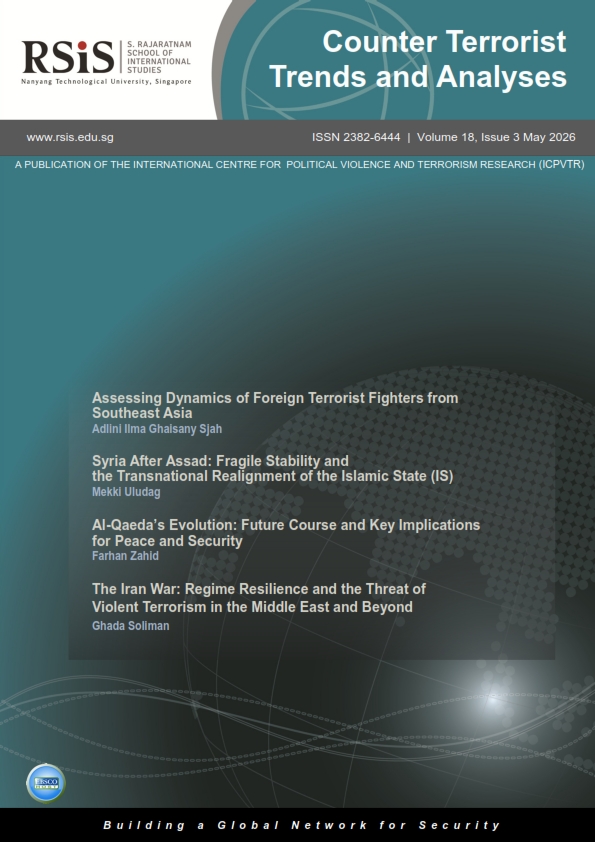
Counter Terrorist Trends and Analyses (CTTA) – Volume 18 Issue 03

Editorial Note: The Persistence and Evolution of Transnational Terrorism amid Resurgence of Inter-State Conflicts
As inter-state conflicts – the US-Israel-Iran war, the Russia-Ukraine conflict, and Afghanistan-Pakistan tensions – reassert themselves as the defining feature of international security, transnational terrorism persists in the background. Unresolved issues, such as the legal status of the Foreign Terrorist Fighters (FTFs), left in the wake of Islamic State’s (IS) expulsion from Iraq and Syria, also remain unresolved. While Al-Qaeda and IS may be past their prime, both have adapted by decentralising operations, empowering regional affiliates, and forging alliances with local jihadist groups across fragile regions in Asia and Africa.
Against this backdrop, the current issue features four articles examining global jihadism’s transformation, relevance, and enduring challenges that risk reviving old asymmetric threats in new forms. Al-Qaeda and IS have already positioned themselves at the sidelines of the ongoing interstate conflicts to exploit emerging security and governance vacuums. IS’ resurgence in the post-Assad Syria and Al-Qaeda’s current strides in Mali through its affiliate Jama’at Nusrat al-Islam wal-Muslimin (JNIM) highlight the need to balance inter- and intra-state conflict considerations in shaping international security strategies.
In the first article, Adlini Ilma Ghaisany Sjah assesses the dynamics of foreign FTFs from Southeast Asia (SEA). She argues that SEA jihadist participation differs from global patterns and varies within the region, noting Afghanistan, Syria, and the southern Philippines as notable conflicts for SEA FTFs. Drawing on Indonesian case studies, the author finds that the impact of returning fighters has weakened over time, with recent attacks and plots more often facilitated by Indonesian FTFs stationed abroad rather than returnees, in addition to domestic terrorists. When evaluating FTF repatriation policy in the present context, more emphasis should be placed on risk assessments around transnational networks and remote facilitation in addition to focusing on returnees. Monitoring mechanisms and tailored rehabilitation strategies should also be strengthened.
Next, Mekki ULUDAĞ explores security developments in Syria over 2024–2026. His focus is on the persistence, adaptation, and renewed activity of IS and analogous jihadist movements. The author situates these dynamics within the broader US–Israel–Iran conflict and examines the way local, national, and transnational actors interact within this volatile landscape. Under Ahmad al-Sharaa’s presidency, Syria’s transitional government faces a dual crisis of legitimacy: managing internal dissent while addressing the broader risk of renewed radical jihadism. Such concerns are exacerbated by the uneven reach of security forces, and the economic vulnerabilities of war-torn communities. The author maintains that Syria’s transitional trajectory is intimately linked to the strategic adaptation of IS, making the management of insurgent networks, detainees, and regional security dynamics central to understanding both national stabilisation and the broader transnational jihadist landscape.
Then, Farhan Zahid dissects Al-Qaeda’s evolution from a centralised global jihadist group into a decentralised network of regional jihadist affiliates. He maintains that sustained international counter terrorism pressure between 2001 and 2020, leadership decapitations, and competition from IS compelled Al-Qaeda to adopt strategic patience, prioritising local insurgencies over large-scale international attacks. The author highlights the growing significance of Al-Qaeda’s regional affiliates such as JNIM in the Sahel, Al-Shabaab in Somalia, Al-Qaeda in the Arabian Peninsula (AQAP) in Yemen, and al-Qaeda in the Indian Subcontinent (AQIS) in South Asia. Al-Qaeda’s relationship with its regional affiliates demonstrates how it embeds within fragile states to exploit governance vacuums. While no longer the dominant global jihadist force, Al-Qaeda remains a persistent and adaptive threat with long-term implications for regional stability and international security.
Lastly, Ghada Soliman argues that the US-Israel-Iran conflict has empowered rather than weakened the Islamic Revolutionary Guard Corps (IRGC) in Tehran. It has adapted by entrenching a decentralised “mosaic defensive” doctrine, allowing regional proxies and affiliated networks greater operational autonomy while maintaining strategic coherence. This evolution is reinforced by a ‘global mujahid’ narrative that frames Iran’s struggle in transnational, sectarian-solidarity terms, helping to mobilise and legitimise Shia militant actors beyond Iran’s borders. A deteriorating diplomatic environment and shift toward more sustained confrontation have been accompanied by the activation of covert networks—reportedly including Hezbollah-linked sleeper cells —suggesting an expanded reliance on asymmetric and deniable tactics. The current trajectory suggests a more fragmented but resilient threat landscape, where state and non-state actors interact fluidly, raising the risks of miscalculation, indirect confrontation, and geographically dispersed instability.
HTML Article Versions
Assessing Dynamics of Foreign Terrorist Fighters from Southeast Asia
Syria After Assad: Fragile Stability and the Transnational Realignment of the Islamic State (IS)
Al-Qaeda’s Evolution: Future Course and Key Implications for Peace and Security
The Iran War: Regime Resilience and the Threat of Violent Terrorism in the Middle East and Beyond
Editorial Note: The Persistence and Evolution of Transnational Terrorism amid Resurgence of Inter-State Conflicts
As inter-state conflicts – the US-Israel-Iran war, the Russia-Ukraine conflict, and Afghanistan-Pakistan tensions – reassert themselves as the defining feature of international security, transnational terrorism persists in the background. Unresolved issues, such as the legal status of the Foreign Terrorist Fighters (FTFs), left in the wake of Islamic State’s (IS) expulsion from Iraq and Syria, also remain unresolved. While Al-Qaeda and IS may be past their prime, both have adapted by decentralising operations, empowering regional affiliates, and forging alliances with local jihadist groups across fragile regions in Asia and Africa.
Against this backdrop, the current issue features four articles examining global jihadism’s transformation, relevance, and enduring challenges that risk reviving old asymmetric threats in new forms. Al-Qaeda and IS have already positioned themselves at the sidelines of the ongoing interstate conflicts to exploit emerging security and governance vacuums. IS’ resurgence in the post-Assad Syria and Al-Qaeda’s current strides in Mali through its affiliate Jama’at Nusrat al-Islam wal-Muslimin (JNIM) highlight the need to balance inter- and intra-state conflict considerations in shaping international security strategies.
In the first article, Adlini Ilma Ghaisany Sjah assesses the dynamics of foreign FTFs from Southeast Asia (SEA). She argues that SEA jihadist participation differs from global patterns and varies within the region, noting Afghanistan, Syria, and the southern Philippines as notable conflicts for SEA FTFs. Drawing on Indonesian case studies, the author finds that the impact of returning fighters has weakened over time, with recent attacks and plots more often facilitated by Indonesian FTFs stationed abroad rather than returnees, in addition to domestic terrorists. When evaluating FTF repatriation policy in the present context, more emphasis should be placed on risk assessments around transnational networks and remote facilitation in addition to focusing on returnees. Monitoring mechanisms and tailored rehabilitation strategies should also be strengthened.
Next, Mekki ULUDAĞ explores security developments in Syria over 2024–2026. His focus is on the persistence, adaptation, and renewed activity of IS and analogous jihadist movements. The author situates these dynamics within the broader US–Israel–Iran conflict and examines the way local, national, and transnational actors interact within this volatile landscape. Under Ahmad al-Sharaa’s presidency, Syria’s transitional government faces a dual crisis of legitimacy: managing internal dissent while addressing the broader risk of renewed radical jihadism. Such concerns are exacerbated by the uneven reach of security forces, and the economic vulnerabilities of war-torn communities. The author maintains that Syria’s transitional trajectory is intimately linked to the strategic adaptation of IS, making the management of insurgent networks, detainees, and regional security dynamics central to understanding both national stabilisation and the broader transnational jihadist landscape.
Then, Farhan Zahid dissects Al-Qaeda’s evolution from a centralised global jihadist group into a decentralised network of regional jihadist affiliates. He maintains that sustained international counter terrorism pressure between 2001 and 2020, leadership decapitations, and competition from IS compelled Al-Qaeda to adopt strategic patience, prioritising local insurgencies over large-scale international attacks. The author highlights the growing significance of Al-Qaeda’s regional affiliates such as JNIM in the Sahel, Al-Shabaab in Somalia, Al-Qaeda in the Arabian Peninsula (AQAP) in Yemen, and al-Qaeda in the Indian Subcontinent (AQIS) in South Asia. Al-Qaeda’s relationship with its regional affiliates demonstrates how it embeds within fragile states to exploit governance vacuums. While no longer the dominant global jihadist force, Al-Qaeda remains a persistent and adaptive threat with long-term implications for regional stability and international security.
Lastly, Ghada Soliman argues that the US-Israel-Iran conflict has empowered rather than weakened the Islamic Revolutionary Guard Corps (IRGC) in Tehran. It has adapted by entrenching a decentralised “mosaic defensive” doctrine, allowing regional proxies and affiliated networks greater operational autonomy while maintaining strategic coherence. This evolution is reinforced by a ‘global mujahid’ narrative that frames Iran’s struggle in transnational, sectarian-solidarity terms, helping to mobilise and legitimise Shia militant actors beyond Iran’s borders. A deteriorating diplomatic environment and shift toward more sustained confrontation have been accompanied by the activation of covert networks—reportedly including Hezbollah-linked sleeper cells —suggesting an expanded reliance on asymmetric and deniable tactics. The current trajectory suggests a more fragmented but resilient threat landscape, where state and non-state actors interact fluidly, raising the risks of miscalculation, indirect confrontation, and geographically dispersed instability.
HTML Article Versions
Assessing Dynamics of Foreign Terrorist Fighters from Southeast Asia
Syria After Assad: Fragile Stability and the Transnational Realignment of the Islamic State (IS)
Al-Qaeda’s Evolution: Future Course and Key Implications for Peace and Security
The Iran War: Regime Resilience and the Threat of Violent Terrorism in the Middle East and Beyond


